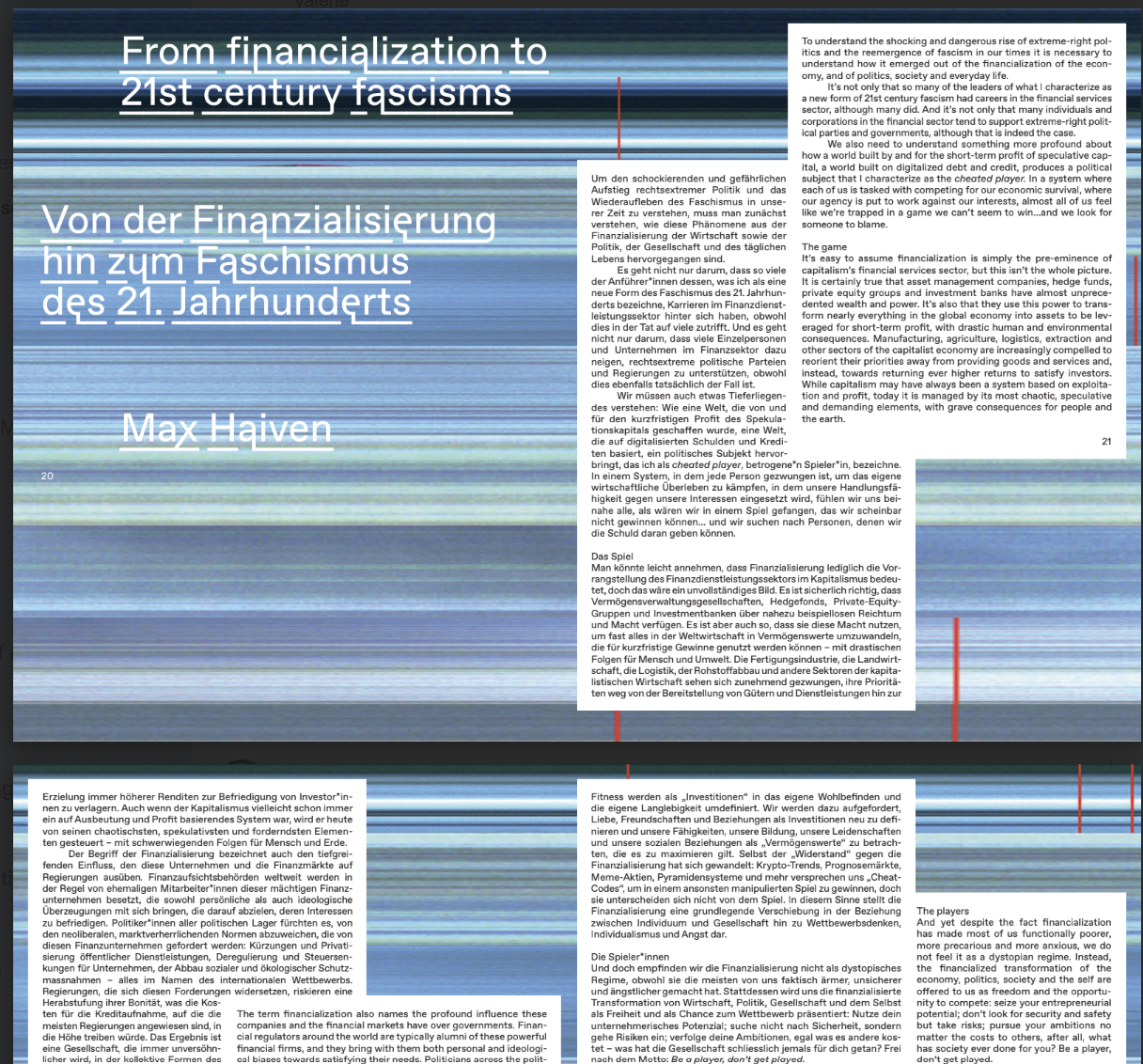
The following essay was published in June 2026 in the 13th issue of For Magazine.
To understand the shocking and dangerous rise of extreme-right politics and the reemergence of fascism in our times it is necessary to understand how it emerged out of the financialization of the economy, and of politics, society and everyday life.
It’s not only that so many of the leaders what I characterize as a new form of 21st century fascism had careers in the financial services sector, although many did. And it’s not only that many individuals and corporations in the financial sector tend to support extreme-right political parties and governments, although that is indeed the case.
We also need to understand something more profound about how a world built by and for the short-term profit of speculative capital, a world built on digitalized debt and credit, produces a political subject that I characterize as the cheated player. In a system where each of us is tasked with competing for our economic survival, where our agency is put to work against our interests, almost all of us feel like we’re trapped in a game we can’t seem to win… and we look for someone to blame.
The game
It’s easy to assume financialization is simply the pre-eminence of capitalism’s financial services sector, but this isn’t the whole picture. It is certainly true that asset management companies, hedge funds, private equity groups and investment banks have almost unprecedented wealth and power. It’s also that they use this power to transform nearly everything in the global economy into assets to be leveraged for short-term profit, with drastic human and environmental consequences. Manufacturing, agriculture, logistics, extraction and other sectors of the capitalist economy are increasingly compelled to reorient their priorities away from providing goods and services and, instead, towards returning ever higher returns to satisfy investors. While capitalism may have always been a system based on exploitation and profit, today it is managed by its most chaotic, speculative and demanding elements, with grave consequences for people and the earth.
The term financialization also names the profound influence these companies and the financial markets have over governments. Financial regulators around the world are typically alumni of these powerful financial firms, and they bring with them both personal and ideological biases towards satisfying their needs. Politicians across the political spectrum fear deviating from the neoliberal, market-supremacist norms demanded by these financial companies: cuts to and privatization of public services, deregulation and tax cuts for corporations, the gutting of social and environmental protections, all in the name of international competition. Governments that refuse these demands risk being punished by having their credit-rating destroyed, which would raise the cost of borrowing, on which most governments depend. The result is a society that becomes ever more unforgiving, where collective forms of wealth and insurance evaporate and individuals are increasingly responsible for their fate.
But financialization also means something more profound. On the level of institutions and everyday life, the last four decades of waxing financial power have fundamentally transformed society itself. We are all expected to become savvy financial “players” now, navigating an world without guarantees. Housing is no longer merely a matter of shelter, but an “investment” individuals and families are obliged to make to built wealth for an increasingly uncertain future. More people than ever are involved in the stock market, buying and selling securities or other financial products on smartphone apps, hoping to beat the market. Health, diet and fitness are reconfigured as “investments” in one’s wellbeing and longevity. We are invited to recast romance, friendships and relationships as investments and to reimagine our skills, education, passions and social relations as “assets” to be leveraged. Even “resistance” to financialization has been transformed: crypto fads, prediction markets, meme stocks, pyramid schemes and more promise us the “cheat codes” to win at an otherwise rigged game, but they are simply more of the same. In this sense, financialization represents a fundamental shift in relationship between individuals and society towards competitiveness, individualism and fear.
The players
And yet despite the fact financialization has made most of us functionally poorer, more precarious and more anxious, we do not feel it as a dystopian regime. Instead, the financialized transformation of the economy, politics, society and the self are offered to us as freedom and the opportunity to compete: seize your entrepreneurial potential; don’t look for security and safety but take risks; Pursue your ambitions no matter the costs to others, after all, what has society ever done for you? Be a player, don’t get played.
The popularity of series like Squid Game or The Hunger Games reveal the anxieties of a society where we are all compelled to play a high-stakes game from which we cannot escape, the thrill and the terror of the war of all against all. In such a world, the worst thing is to be an NPC (non-player character), a mindless drone destined to unreflexively follow your program and be merely a tool, and obstacle or a slaughterable opponent for the real players. 21st century capitalism may still exploit many of us in the familiar ways: by making us work to produce value for our bosses; by expecting us to reproduce life (have children, restore our bodies, make society work) for free; by displacing us from the land to rip stuff out of it. But today’s capitalism also relies on most of us being consumers and, what’s more, competitors. Platforms like Uber, Airbnb or OnlyFans herald the horizon of capitalism where we will all compete for a chance to work or make an income leveraging whatever assets we’ve got: three hours for driving between 3-6am, a spare room, beautiful feet… Everyone must have a side-hustle, a side-side-hustle, and so on. This is a form of capitalism that also exploits us through our agency, through our capacity and enthusiasm to play the game.
Is it any wonder that the world’s most financialized and powerful country selected, as their president, the ultimate player? Was he not, after all, the star of a “reality” TV show where contestants compete to impress him with their cutthroat entrepreneurial instincts? But around the world, far-right (indeed, often fascistic) politicians have rocketed to victory with claims that they and they alone understand and can speak for the player in all of us. Unlike the ultranationalists of old, who promised to harness the capitalist bull to the nation’s chariot in the name of stability and prosperity for all (although not all equally), today’s reactionaries promise only to unleash the wolf of wall street in each of us. They declare war not merely on “the swamp” of state bureaucracy but on anyone or anything that might inhibit or discourage each of us from the ruthless competition. What’s more, they promise revenge.
The cheats
Why isn’t the financialized game working for most of us? We are told it is because the hard-working, rules-obeying players are being cheated: Welfare and social assistance claimants are taking advantage of and scamming our generosity to live lives of ease; Migrants and refugees are cheating the border to steal our wealth and abuse our hospitality. Racialized “special interest groups” are manipulating the miseducated guilt of the majority to cheat the meritocracy and get ahead; Environmentalists and other social activists are either naïve or duplicitous, but, in any case, aim to cheat the nation of its wealth and competitiveness; “Elites” (a conspiracist phantom that lumps selected members of the ruling class with convenient liberal politicians) are using their wealth and power to game elections and manipulate the media to cheat the real people of the nation out of their democracy rights. Cheats are everywhere and you can’t trust anyone, hence the need for more police, surveillance, and military might.
These sentiments tend towards reactionary politics and fascism, but fascism in a uniquely 21st century idiom. Many critics have rightly noted that we should not expect the form of fascism that might emerge from a media ecology of many-to-many platforms and social networks to look like the one that emerged from last century’s one-to-many broadcast media (film reels, radio, mass rallies). But what many of these analyses miss is the political-economic dimension. Fascism is not just the reawakening of humanity’s timeless curse of tyranny. It is authoritarian, but so are other regimes. What sets fascism apart is that it arises out of and promises (false, usually catastrophically violent) solutions to the crises of capitalism. It bears the features of the capitalism within which it incubated. And as capitalism changes, so does the forms of fascism that it spawns.
Revenge
Today’s fascist politics are the revenge of the cheated player. They appeal to that those of us that has been transformed by financialization into a competitive player, who have been expected to transmute all aspects of life into assets to be leveraged, who have been exploited through our agency… and yet who feel that, despite all our earnest efforts, we simply cannot seem to win. Unlike 20th century fascisms, that offered the sadomasochistic pleasure of subordinating the self to the mass, today’s market-supremacist fascisms promise to liberate the individual to compete, and to cleanse the nation of the parasites who threaten to undermine that competitiveness. The fascisms of last century promised to save The People from capitalism, either by taking direct control of the economy or forcing capitalists to serve the Nation. Today’s fascisms are accelerationist: they come to complete the neoliberal revolution by any means necessary, even if it costs the earth itself. All fascism is racist, but as numerous critical scholars of race observe, this pernicious ideology is a shapeshifter: today, even racialized minorities can be conscripted to vote for the mass incarceration, deportation, and punishment of people who look like them in the name of cleansing society of parasites. Fascism is always misogynist and nostalgic for a “traditional” time that never was, but today fantasies of the restoration of the patriarchal family and traditional lifestyles are recast to conform to the ideals of a society of competitive sovereign households headed my miniature warlords guided only by their own morality. And while 20th century fascists promised to take power and abolish democracy in the name of letting a strong, centralized leader take over the state, today’s 21st century fascists asset-strip and weaponize democracy, empowering majorities to abuse minorities and destroying those democratic institutions that might provide any accountability: independent institutions of media, research, justice, education, etc.
Thus, in contrast to fascism movements of the past, today’s are highly disorganized and entrepreneurial: rather than a single blaring loudspeaker, we have a million competing influencers seeking to both profit and persuade. Today’s forms of fascist violence increasingly look like digitally-mediated swarms, “playgroms” that flock together and disperse, accelerated by vast online conspiracist communities, iconically at the 6 January 2021 riots in Washington DC but also elsewhere. 20th century fascism aimed to put the industrialization of life in the hands of a political theology, essentially transforming society into a machine of violence oiled by vicious ideology. 21st century fascism is a virus in the network, transforming each individual into a replicator of a nihilistic capitalism in extremis.
The tide of fascist ideology must be turned back. It’s not just that, if allowed to sweep over our societies it will delivery ruthless tyranny and untold misery. Fascist ideology does not always lead to a totalitarian regime, even if its proponents want one. Nonetheless, this reactionary wave will leave profound destruction in its wake.
In order to undertake this work, however, we must move beyond the assumption that arguments and narratives are the only substance of politics. If we learn anything from the devolution of financialized capitalism into 21st century fascism it should be to attend to the power of agency. Financialized capitalism captures and exploits us in large part by seducing and exciting our agency, our freedom to act strategically within artificial constraints, structures and scarcities we mistake for natural, necessary or inevitable. A world of relentless and merciless competition is sold to us as liberation and opportunity. 21st century fascism does not emerge from the zombie-like ideology of the mass following the god-like dictator, but the ideological entrepreneurialism of millions of would-be players. Fascistic spectacles and political communities reflect this: they offer their participants the feeling of competitive volition, ephemeral community and individual agency in a world where, otherwise, most of us feel like losers or NPCs.