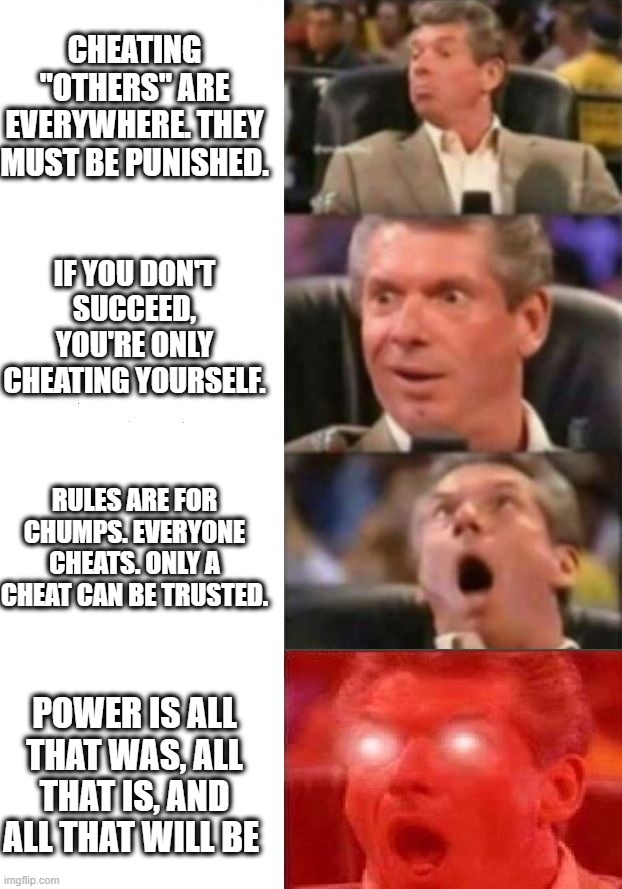
Cheating has become a pivotal political category in a moment of ascendant fascistic politics in the United States and elsewhere. This essay explores a number of examples from US popular culture where a reactionary politics around cheating take shape, constituting part of the public pedagogy of what I term gamed capitalism. That is a form of capitalism where our agency is elicited (rather than repressed) and where we are each conscripted to cultivate ourselves as a “player” of often exploitative games. Here, a contradictory reactionary politics circulate around the figure of the cheat: on the one hand, they would appear to undermine a capitalist meritocracy that is presumed fair; on the other, we all know that only cheaters win, and that we must all strive to win at all costs. By examining the public pedagogy of pyramid schemes, sexist romantic advice, misogynist influencers and professional wrestling, we can gain a more capacious understanding of how the dispositions, subjectivities, affects and forms of relationality of gamed capitalism tend toward fascistic politics.
This article will appear in a forthcoming 2026 issue of The Review of Education, Pedagogy and Cultural Studies.
Cheating and the fascistic public pedagogy of gamed capitalism: Pyramid schemes, sexist advice, misogynist scams and the perfect perfect bastard
Max Haiven, 2026
Introduction
This paper concerns how, in the contemporary United States and beyond, a contemporary public pedagogy of “gamed capitalism” circulates around the theme of cheating and how this contributes to the rise of fascistic politics. By looking at recent examples of pyramid schemes, dating advice, misogynistic influencers and professional wrestling, we can begin to discern how a set of reactionary ideas, affects and modes of subjectivity cohere that are preoccupied within a contradiction: on the one hand, American and associated anglosphere capitalism is presented as an open and competitive meritocratic game where the smart, perseverant and industrious can succeed; on the other, there is a widespread acknowledgement that cheating is normal, inevitable and even praiseworthy. This lends itself to the rise of fascistic politics where reactionary political figures to mobilize vitriol against supposed cheats (migrants, welfare claimants, “elites,” etc.) while at the same time making a virtue of their own often transparent cheating.
This paper is part of a wider effort to understand the rise of fascistic politics within what I call gamed capitalism (Haiven, 2026b). The term refers in part to a form of capitalism where games (especially digital games) are a pivotal cultural industry and site of meaning-making (see Did, 2024). It goes beyond a concern with gamification (the integration of game mechanics or elements into non-game contexts), which has been a major element in the restructuring of public education and integral to the intensification of “surveillance capitalism” (Hon, 2022). The notion of gamed capitalism also speaks to a broader cultural idiom where, a half-century into the neoliberal revolution, almost all social subjects have been tasked with cultivating the disposition of the competitive “player” in nearly all aspects of life, from employment to romance, from housing to fitness, from education to creativity. As Patrick Jagoda (2020) argues, the society of the spectacle has in many ways become the society of games: whereas Guy Debord (1994) theorized a moment of postwar consumer capitalism where the commodity form crystalized into conservative images and lifestyles to be consumed, today the economy feels like an endless maze of “gamed” experiences which both elicit and ensnare our agency, although rarely in our interests (see also Wark, 2007). We players feel, increasingly, played.
But unlike the protagonists of the popular Hunger Games or Squid Game franchises, who strive to band together to overthrow the rigged games in which they are forced to play, today a fascistic politics is on the rise which further integrates us into gamed capitalism. Offering no meaningful systemic change,such politics mobilize themselves around both the love and the loathing of cheats. On the one hand, the seductive political rhetoric of a new generation of fascistic political personalities gravitates around accusations that the hard-working and rules-abiding citizen is being cheated. Donald Trump is only the most extreme, charismatic and successful example, whose political speeches are filled with accusations of cheating: migrants are said to be cheating the border to rob the nation of jobs and commit criminal acts; welfare claimants are accused of cheating to pursue lives of debautched ease; environmentalists are rumored to be in league with foreign powers to sabotage the nation’s prosperity; trans women are held to be cheating at sports and cheating cis women of their safety; racialized people are accused of preying on white guilt to gain special advantages in education and the workplace and so cheating the capitalist meritocracy. Nebulously defined political and economic “elites” are said to be rigging democracy and capitalism for their own self-interest or ideological proclivities… The list goes on, and similar rhetoric is echoed by popular far-right figures in Canada, the UK, Australia and beyond (see Haiven, 2026b).
The success of this rhetoric is surprising given that so many fascistic personalities and politicians are themselves cheats, and often proudly so. Donald Trump not only disregards the rules governing the speech and decorum of a public official, it is also almost certain he and his family and close associates have engaged in egregious fraud and insider trading, and he has bragged openly about cheating at business, in sports, and on his wife.
My purpose here is not to litigate Trump or other fascistic politicians’ or personalities’ malfeasance but, rather, to say something more broadly about how cheating became such a pivotal category of cultural politics in this fraught moment. By examining the way cheating comes to be seen as normal, inevitable and even praiseworthy across several popular cultural sites we can begin to reckon with the broader paradigm of gamed capitalism in which we live, and the ways that it incubates within it the kind of reactionary ideologies and affects I associate with fascistic politics.
After providing more context for this essay’s key terms, this essay will provide a reading of four popular cultural phenomena that involve cheating. These, I suggest, point toward what I will frame as the public pedagogy of gamed capitalism, which both depends on and helps reproduce the disposition of the “player”: first, the rise of the pyramid scheme, which transparently cheats its enrollees, but in the name of supporting their entrepreneurial yearning to be a player; second, the genre of popular romantic advice writing (with titles like The Rules and The Game) that purport to share timeless wisdom about how to “win” marriage or sex and that suggest that those who fail to recognize and embrace these truths are “cheating themselves”; third, the rhetoric of the fascistic and misogynist influencer and serial scammer Andrew Tate, who promises his millions of fans (almost exclusively young men) the “cheat codes” to accumulate and exploit money and women; finally, the mediated commercial spectacle of “professional” wrestling where, in recent years, cheating has become a pivotal element of a multi-billion dollar game with real world political consequences. The paper concludes with a discussion of why the public pedagogy of the cheat under gamed capitalism lends itself toward fascistic politics.
Gamed capitalism and fascistic public pedagogy
As Mike Cole (2020) argues, the concept of public pedagogy, while originally deployed by critical and feminist educational scholars to recognize efforts toward social justice outside formal learning settings, is highly useful for understanding how fascistic politics proliferate. This is not only because fascistic actors use media platforms, mass rallies and other spectacles to intentionally propagandize their messages. It is also because, as Jack Bratich (2022) makes clear, fascistic politics proliferate in the realm of ideological meaning-making and take root at the level of affect, subjectivity, relationality and the body through an often subtle and indirect set of processes. The term public pedagogy, which speaks to a process whereby a subject is (mis)educated beyond the classroom, grasps something vital about how fascistic politics are “taught” over time, not merely through didactic discourse but also through example, insinuation, habituation, relationality and play.
Theorists of fascism note that the term can be used to identify a more or less coherent ideology, the way this ideology occasionally congeals into political movements, and the regimes such movements sometimes institute if they take power; this paper only concerns the first of these. But my use of the term fascistic politics speaks to something wider than merely the doctrine espoused by self-identifying fascists. Fascistic politics is not unified or clearly definable and can often take different forms. But, as Umberto Eco (1995) argues of fascism generally, all instances of fascistic politics share a certain number of hereditary “family characteristics.” These might be said to include (but are not limited to) the worship of power, violence and authority; a belief that the nation or political community is under fatal threat from internal and external enemies and can only be saved or redeemed by revolutionary methods; an obsession with the purification of the nation (or political community) and revenge against those blamed for its decline; a virulent politicized nostalgia; a set of paranoid reactionary constructs around race, gender and sexuality; and a loathing for left-wing and progressive politics. A number of more recent scholars have noted that, unlike their 20th century predecessors, today’s fascistic politics mobilize democracy (rather than seek to overthrow it) and use it to attack the rights of minoritized groups (see Traverso, 2019). They also see capitalism not as a threat to the national community but as the right and just arena for exhibiting supremacy (see Toscano, 2023). As Kevin Siefert (2024) elaborates, in a neoliberal age that individualizes shared social problems (precarity, poverty, uncertainty), a wide range of actors, not all of whom would consider themselves fascists (or know what the term means), can contribute to a form of ambient education that produces fascist ideology. As Michalinos Zembylas (2022) and Katie Sloan (2026) argue, part of cultivating an antifascist educational program is recognizing the way fascistic ideas, tropes and ideologies are spread, normalized and integrated into the worldview of individuals by such a public pedagogy.
I follow these and other authors, including Evans and Giroux (2020) and Alberto Toscano (Lewis, Krabbe and Toscano, 2024), in naming these politics as fascistic (in contrast to parallel terms like authoritarian, totalitarian, reactionary and far-right) because it brings us into alignment with a long history of antifascist thought that maps how forms of fascistic politics emerge from and offer a (false, violent) reaction to the contradictions and crises of capitalism (see Haiven, 2026b). These crises and contradictions are historically contingent. My argument here and elsewhere is that today’s forms of fascistic politics emerge within and as a reaction to gamed capitalism.
By appending the adjective “gamed” to capitalism I am not seeking to make a categorical statement about a new phase or era of that system of private accumulation but, rather, to draw attention to one way of looking at important recent shifts at the intersection of political economy and cultural politics. In the first place, it highlights the meteoric rise of games as a central cultural industry, especially video games (Did, 2024). This is significant for a few reasons. For one, the conditions of work and workers in the games industry can fruitfully be read as indicative of trends in capitalism as a whole: the industry is characterized by precarious employment that makes workers compete for increasingly episodic contracts in the name of “doing what they love,” or that “empowers” workers to form their own companies and self-exploit in the hopes that their games will succeed through sales via highly extortionate digital corporate gatekeepers (Woodcock, 2019). In the games industry and in gamed capitalism in general, the line between producer and consumer is blurred. and where a huge amount of the value of the product comes from consumers’ engagement with the product, for instance populating and enriching online worlds or elaborate fan cultures that are profoundly economically and culturally significant (Goggin, 2011; Massanari, 2024). This was emblematized by the so-called #Gamergate antifeminist online swarming campaign, what I have elsewhere characterized as a “playgrom” which was fostered, studied and capitalized upon by the American far-right and in many ways served as a template for new forms of decentralized reactionary political organizing (Haiven, 2025).
In the second place, gamed capitalism draws our attention to the importance of gamification to the rise of digital platform capitalism. Critical scholars have sounded the alarm that enthusiasm for “gamified” education apps (based often on dubious learning outcomes) has been used as part of an attack on public education (Tulloch and Randell-Moon, 2018). More generally, the integration of game mechanics and elements into all manner of digital processes and platforms largely serves to help corporations harvest data or sell user attention, and its integration into platform employment software, such as those used by Uber drivers or Amazon warehouse workers, serves to divide workers who are now recast as competitive entrepreneurs and accelerate their exploitation (Hon, 2022).
This opens onto a third and more general meaning of gamed capitalism: a system that exploits people in part through their own agency. Whereas other modes of capitalist accumulation are content to use the threat of violence or privation to motivate workers, gamed capitalism is adept at providing a multitude of game-like platforms and scenarios where we each may put our ingenuity, perseverance and competitiveness to the test for our personal gain in a world of neoliberalism’s artificial scarcity and sabotaged meritocracy (see Littler, 2017; Paul, 2018). The would-be social media influencer, who leverages their whole persona to “win” a chance at precarious and fleeting fame and fortune on a gamified corporate platform, is at the vanguard of a mode of capitalist exploitation that insists we all, in any and all aspects of our life, recognize and cultivate ourselves as a “player” (Bollmer and Guinness, 2024).
As I have explored elsewhere (Haiven, 2026a), the metaphor of capitalism as a game has been with us for centuries. Liberal philosophers have wagered that while capitalism may not produce equality, it is fair and just because it (and arguably it alone) is a system governed not by a self-reproducing elite but by a set of universal rules that produce “procedural” justice: essentially, the equal opportunity to compete in a fair game (Garthoff, 2014). As neoliberal policies and the financialization of the capitalist economy have created a world ever more subordinated to the market, where more and more aspects of life become competitive arenas, the metaphor of the game has become ideologically pivotal (Jagoda, 2020; Wark, 2007).
At the end of this paper I will propose that fascistic politics today appeals to the archetype of the “cheated player,” who both feels robbed of their ability to compete in gamed capitalism by nefarious cheats, but who also recognizes that cheating is natural, normal and inevitable and so also admires and accepts powerful cheats. I believe that this approach can help us better comprehend some of the key dynamics and contradictions of fascistic politics in our times. To unpack this, I now turn to several (seemingly) nonpolitical scenes from popular culture where the complexities of cheating under gamed capitalism unfold. I will be content to simply define cheating as intentional and dishonest advantage-seeking in contravention of a supposedly fair and universal set of rules (for a more robust definition, see Green, 2004).
Pyramid schemes
Pyramid schemes are a startlingly popular and influential genre of legal capitalist scam that cheat people out of billions of dollars each year. They are fundamentally exploitative of those whom they attract , but the promise their targets a method to legally cheat at capitalism to get (paradoxically) what they deserve. As journalist Bridget Read (2025) has recently shown, pyramid schemes have sold the myth of entrepreneurship to hundreds of millions of people in the US and around the world (see also Weigel and Cameron, 2026). And its most successful chieftains have used their ill-got profits to fund and support extreme right, often fascistic forces.
In a pyramid scheme, a person is approached by someone already in the organization to become a retail salesperson for a product (typically cosmetics, diet supplements or health products). The prospective inductee will not be an employee but, rather, an independent contractor. They are entitled to buy items at a discount and sell them at a (usually specified) markup, but must provide their own capital and infrastructure (in most cases this includes a social or family network to whom they can sell products) and are obliged to give a share of the proceeds or a regular fee to the “upline” person who brought them into the scheme (who, in turn, pays out to their own upline and so on) in return for coaching, advice and support. New “downline” salespeople keep their profit, but are also encouraged to recruit new independent sellers, who will be obliged to pay them a cut of their proceeds in the future, this being the most lucrative part of the business. Often, membership in such a pyramid requires sellers to also invest in educational materials and events from the parent company. In many senses, pyramid schemes are gamified: they have rules, rewards, and penalties; they encourage their inductees to strive to reach goals; the most successful include challenge, prizes, leaderboards, rankings, and more generally an atmosphere of comradely competition.
While such schemes are typically sold as a means to make a living or extra income, the vast majority of participants barely break even or even lose money, while successful pyramid schemes funnel millions or billions of dollars to the founders, owners, and most those most successful at recruiting new participants. Even though they are, transparently, scams, the most successful pyramid scheme present themselves to their targets as a kind of legal cheat within capitalism, a way to gain access to capital without the common exploitation and alienation of the wage relation.
While the pyramid scheme was first popularized and remains deeply influential in the USA, it has spread around the world and can be found in nearly every capitalist country (Miranda, 2024). They have had particularly catastrophic consequences in post-socialist nations, notably Albania where a rapacious and government-sponsored scam to cheat people out of their newly-privatized housing led to the brink of a civil war (Musaraj, 2011). Pyramid schemes prey upon sellers tapping and exploiting their social networks, family, neighbors, and coworkers as potential customers and recruits, essentially financializing the sphere of social reproduction. Read’s journalistic book brings us the stories of many lives, friendships and families torn apart as desperate sellers, eager or required to make back their initial investment in stock or to gain the affirmation and wealth of climbing the pyramid, harangue, or manipulate themselves and those around them. The pyramid scheme works in part because it preys on its target’s sense of optimism and their wish to “be their own boss” in a system where most work is boring, alienating, dehumanizing, and exploitative (Wrenn, 2023). It at first appears to present very little risk and has basically no major barriers to entry: signing up is easy and selling the product is also fairly straightforward. But successful pyramid schemes, notably the world’s largest, Amway (short for “The American Way”), also sell themselves (in their promotional and educational materials, and in the propaganda of upline recruiters) as a way that people who have been deprived of opportunities to succeed in the capitalist meritocracy can seize the moment and achieve wealth through hard work and perseverance (see also Mondom, 2018). In both Amway and Marie Kay (the other major global pyramid scheme, this one exclusively targeting women to sell cosmetics), personal striving for wealth is also partly repackaged as access to a supportive community. While sellers are inherently competitive with one another to sell products and recruit new downlines, they are also encouraged to espouse and embrace a disposition of cheery conviviality and mutual encouragement in online communications (usually on the scheme’s proprietary social networks) and compulsory in-person conventions, both of which are saturated with optimistic, wholesome and inspiring messaging. In this sense, such scheme also offers many of their participants a kind of synthetic proxy for community, providing paid opportunities to gather at carnivalesque conventions.
While this explicit rhetoric is relentlessly positive, focusing on how the schemes bring out the best in people and create meaningful friendship and success for participants, we might observe a hidden or implicit negative message, one which is often, Read reports, only articulated by renegade seller-influencers or defectors who use their skills and networks to form their own new pyramid schemes: you, the seller or potential seller, are being cheated. Capitalism is not working for you, not because you lack the requisite drive, ambition, perseverance, or merit, but because some corrupt force has robbed you of opportunity, and, importantly, you have only yourself to blame for being such a dupe. The pyramid scheme, which is at least transparently unfair (it’s clear how it will funnel wealth upwards), will give you the opportunity to actualize your potential (see also Mondom, 2018; Wrenn, 2023). You will be cheated, but on your own terms, by the devil you know and into whose hands you willingly place yourself. If you fail to make money, it’s not because you are being scammed. After all, the scam was already announced from the get-go. Rather, you probably failed because you didn’t work hard enough for yourself, didn’t believe enough in yourself. You ultimately cheated yourself.
Read’s book details the ways in which the pyramid scheme industry has funneled billions of dollars into right-wing think tanks and political campaigns, and also the way it’s programs and propaganda promote and reinforce a patriarchal, reactionary and market-supremacist worldview. Signature among these is the political donations of the DeVos family behind Amway, which has been perhaps the most significant player in the right-wing war against American public education, bankrolling movements for charter schools and voucher systems. In recognition and consummation of this, Betsy DeVos (daughter-in-law of the company’s co-founder and wife of its former CEO) was appointed Secretary of Education under the first Trump administration (Means and Saltman, 2022).
While pyramid schemes are often derided and mocked as scams that play on the poor, financially illiterate and vulnerable, this infamy distracts us from their massive cultural and economic impact. The pyramid scheme is one of the most explicit, transparent and popular means by which gamified, financialized capitalism cheats individuals, and one notable because, like the most cunning of stage magicians, it tells you precisely how it will trick you before it pulls the rabbit from the hat. Transparency is misdirection. The reality is, as Read notes, most pyramid schemes’ underlying narratives and ideologies have become mainstream, thanks to the charisma, PR campaigns and political influence of their founders and profiteers (see also Wrenn, 2023).
For example, the basic structure of the pyramid scheme isat play in many of the schemes and scams associated with the rise (and fall) of the crypto economy, where the affordances of new networked digital technology have been employed to create (seemingly) decentralized “currencies” and immaterial tokens (Swartz, 2022). While hyperbolic rhetoric claimed their emergence was a rebellion against the corruption of capitalism, in fact the vast majority of such initiatives were essentially distributed or decentralized pyramid schemes: they were designed intentionally to capitalize on the cynicism of “investors” who were betting that other “greater fools” would follow, hopefully ballooning the price of the digital asset, leading to a volatile hype-driven economy. Among the most nefarious of these almost completely unregulated scams were those “coins” launched by the Trump family as a fairly naked gambit to make money and sell influence (big investors were awarded invitations to the White House and special access to the administration) (Chayka, 2025; Conroy, 2025). Beyond the malfeasance of these and other actors, what is significant is the general rhetoric that surrounded this bubble economy: for millions of people, especially men, the ability to “invest” in crypto was celebrated as the liberation and empowerment of the “little guy” to succeed at a capitalist game from which they had, hitherto, been excluded (Mendoza-Denton, 2021). Cheated of their opportunity to win by banks, governments and big business, crypto assets were often sold as a “cheat code” or semi-legitimate back door by which anyone could seize their potential and, finally, be a “player.”
Rules girls
In what would become an overture to several decades of antifeminist reaction in self-help and relationship advice, the 1995 bestseller The Rules: Time-tested Secrets for Capturing the Heart of Mr. Right hinges on skepticism towards the sexual revolution, proposing that women have been dangerously mislead by loosened sexual and relationship mores and should return to what the authors imagine to be traditional modes of courtship that strive toward stable, committed relationships, and ultimately marriage (Fein and Schneider, 1995). The titular rules involve a set of guidelines that at first appear to encourage women to value their own self-worth and that make the men they (might) date wait and show respect and devotion before offering communication, affection, connection and sex. (“Don’t Stare at Men or Talk Too Much,” “Stop Dating Him if He Doesn’t Buy You a Romantic Gift for Your Birthday or Valentine’s Day,” “Don’t Expect a Man to Change or Try to Change Him.”)
Implicit in the book is a reiteration of a set of “common sense” heteronormative ideas and ideals: women ought to focus on relationships as a means to material and emotional stability, rather than pleasure; men are inherently manipulative, uncommitted, and licentious, but also tamable by women with sufficient patience and strategy; women largely have themselves to blame if they get dumped because they were too easy or too eager or too clingy or too loud or too annoying. The book explicitly mobilizes the old metaphor of courtship as a game. Like the revelation of the laws of physics, which operated since the birth of the universe but were only revealed to humans by rigorous scientific inquiry, the authors purport to be sharing The Rules to a game that has allegedly been with humans since time immemorial but are only now discernable… for the price of a nonfiction paperback.
Certainly, The Rules offers a great deal of comfort and a useful guide to women navigating a world without guarantees, where heterosexual romance is confusing and exhausting, and where the consequences of snagging a partner are still significant, despite the claims of liberal feminism to have leveled the playing field for women. The simple matter of having a second income in a world of rising housing and household costs, let alone the opportunity to have children in a world with diminishing public childcare, are enough to make The Rules an appealing guide, even 30 years after its initial publication. Whether the guide actually works is another matter, but ideologically The Rules functions to reinforce a range of common sense reactionary views about gender and relationships that resonate with a broader idiom of gamified neoliberal reason, an idiom that would emerge in full force with the advent on online dating platforms (see Rosamond, 2018): Relationships are a high stakes game; only delusionally romantic fools neglect to have a strategy; if you fail, you have no one to blame but yourself; your best game centers around your own self-interest; you are always at risk of being manipulated; empowerment, liberation and the good life don’t come from a collective struggle to overturn the game, but from the ruthless pursuit of your objectives within it; and, of course, nice (and promiscuous) girls finish last… and you might have to cheat a bit to win.
While The Rules does not encourage cheating in terms of sexual infidelity, it does offer itself up as a kind of implict girlboss “cheat code,” or perhaps more accurately what gamers call a walk-through: a step-by-step guide to finding one’s way through a puzzle or the narrative of a role-playing game, which is something like cheating because, according to the norms of the game, part of the challenge is doing it on your own. In the competitive game to “capture the heart of Mr. Right,” the “rules girls” (those who obey the dictates of the book and franchise) are promised they will have the advantage, and indeed it is implied that those women who foolishly choose to play based solely on their own intuition are cheating themselves, either because they are delusional, lazy, debauched, or stupid they don’t even realize they are playing the game. Feminists who might suggest the game is a scam are, of course, spoilsports and killjoys.
Surely, many women have found what they thought they were looking for by following The Rules, or the advice of innumerable social media influences who offer slight variations on its themes—often with a dubious neuroscientific or evolutionary biology or game theory flavoring (Trees, 2009). But in presenting the game and the rules as rigid, eternal, individualistic and competitive, texts like these reify what are, in fact, arbitrary and oppressive social categories, first and foremost those that reiterate a binary gender system and its associated heteronormative expectations. Women might use The Rules to get a cheat code to gain the relationship that is imagined to offer love, material stability, companionship, the opportunity to raise children, sex and self-worth. But these rules ultimately silence the pertinent question of how these legitimate desires might be met by social forms and material institutions beyond the cisheterosexual family, for example through the public provisioning of childcare, housing and old-age security, or by the reform of social norms to prioritize non-sexual friendship, a wider range of consensual sexual relations and the celebration of people’s diverse contributions to their society and community beyond simply being an object of sexual competition or a devoted wife and mother (Lewis, 2022). The Rules and similar reactionary advice media fundamentally cheat us of the radical imagination and the better collective futures it might inspire.
It’s a man’s game
The Rules was indirectly answered a decade later by Neil Strauss’s bestselling journalistic account The Game: Penetrating the Secret Society of Pickup Artists, which was followed in 2008 by the bestselling how-to guide The Rules of the Game and, in 2015, the much less popular The Truth: An Uncomfortable Book About Relationships in 2015. In the original book, the author narrates his decent into a “community” of heterosexual men who pay each other for classes on how to seduce women using what are claimed to be rigorously tested and distilled techniques that manipulate neuroscience, psychology and presumed-natural gender behaviors. Unlike “traditional” techniques like being charming, nice or funny, the ones advocated by the “pickup artists” reflect something more like high-pressure sales or cult recruitment techniques, largely involving making targetted women feel insecure, ignored, confused, unnerved or undesirable such that they naturally seek the attention, affirmation or protection of their manipulator (Bratich and Banet-Weiser, 2019). The leaders of the online and IRL workshops that Strauss documents promise their clients a kind of cheat code to the game of seduction and specifically marketed their product to men who felt their chances to have sex with the women they desired were low because they were physically or personally unattractive.
While feminists and people who cared about the wellbeing of women and of boys’ and mens’s sexual health sounded the alarm about the influence of so-called pickup artists at the time the book was published, the warnings went largely unheeded. Perhaps this is because in many jurisdictions far-right movements have specifically targeted what are likely the most effective spaces and institutions to counter the broader misogynistic and patriarchal ideology: public school sexual health education programs (Venegas, 2022). Even though today pickup artistry is something of an internet relic, it’s basic tenets live on and have become dangerously mainstreamed, notably in the extremely popular rhetoric of key social media influencers associated with mens’ rights, involuntary celibate (incel) and “manosphere” subcultures (Bratich and Banet-Weiser, 2019).
Within the popularized incel worldview, it is men who are being cheated by women, by feminism and by society at large (Tahsin and Shea, 2024; Thorburn, Powell and Chambers, 2023). Proponents argue that humanity is naturally inclined toward a hierarchy of male desirability, with attractive and powerful men at the top, but that in the past evolutionary necessity and traditional norms and institutions ensured that even relatively undesirable men had access to some women’s bodies. This natural order has been cheated thanks to women’s increased economic independence and sexual liberation so that now a small minority of very attractive men monopolize the sexual economy (Bratich and Banet-Weiser, 2019). This toxic narrative also often dovetails with racist and conspiratorial beliefs that elites are orchestrating the migration of nonwhite and non-western people to White and western Nations as part of the great replacement of white people in Western countries, including, salaciously, in the bedroom (on the longer genealogy of such violent paranoia, see Balani, 2023; Motyl, 2024).
The incel subculture gained headlines because it of its deranged ideology and the fact that it has inspired several horrific massacres, many of which have been undertaken in the gamified idiom, played and livstreamed out as if they were first-person shooter video games (see Haiven, 2025). But it only echoes and reinforces a broader set of increasingly popular reactionary ideas that suggest that both men and women have been cheated of their chance to win at the sexual game and find pleasure, companionship and stability in a tumultuous world.
At work in both The Rules and The Game is the ideological understanding that sex and romance can be best understood and approached using the metaphors, procedures and dispositions of gamed capitalism. More recently this has manifested in online folk theory of “Sexual Market Value” which bastardizes academic research to suggest that there is a universal linear scale of attractiveness and desirability that determines not only an individual’s personal chances of romantic success in life but that explains almost all human behavior and social structures (see Cannito and Ferrero Camoletto, 2022). While the details are too convoluted and stupid to parse, the paradigm, which is widely popular in online cultures today, essentially transplants received ideological wisdom about markets onto the most significant aspects of life and society. Part of its success is that it is propounded by hucksters promising to teach subscribers how to increase their SMV or reactionary thinkers who claim that the reality of SMV explains and justifies patriarchy, hierarchy and inequality. Much of the advice concerning SMV, for both men and women, has to do with “cheating”: finding shortcuts, exploits and cheat codes that allow one to leverage one’s intelligence and acumen to increase one’s value in the hierarchy.
Clown worlds
Key and king among the proponents of these theories and techniques at the time of writing is the notorious former mixed martial arts fighter and serial scam artist Andrew Tate, who faces multiple criminal charges of rape and sexual exploitation and trafficking in his native England and in Romania and several civil charges for rape and physical and sexual assault. Some but not all these charges are connected to his business recruiting and promoting young women to produce pornography to be sold on his and other online platforms (Tahsin and Shea, 2024).
Tate represents himself, to the delight of his millions of fans (most of whom are teenage boys) as the ultimate player: a ruthless fighter, a reckless rebel against convention, an arrogant and fearless speaker of harsh truths, a scandalous Casanova, a mixed-race, working class, self-made entrepreneur and a beloved influencer with legions of followers and friends in very high places (notably the Trump White House) (Asher-Schapiro, 2025). He is the author or beneficiary of many scams. He and brother have publicly bragged that their webcam business instructed the women they employed (and exploited) to manipulate male viewers by telling fake “sob stories” to elicit donations and maintain monetized attention. His content creation company Hustler University, which purported to offer special access to his advice and musings, was essentially a pyramid scheme aimed at getting suckers to help popularize his brand. It was shut down (thanks in part to the refusal of various online financial services to support it, fearing liability) and replaced by The Real World and The War Room (“Where is the War Room? Everywhere. The globalization of the world has made it critical to be a part of a world-spanning network”). These franchises include public-facing videos on platforms like YouTube, Instagram and Tiktok (until he was banned) and the far-right content platform Rumble, and a subscription-membership platform aimed at young men to offer them advice and a community, but which actually hawks more get-rich-quick scams, notably dropshipping, ecommerce and cryptocurrency hustles, including his DADDY memecoin, issued in 2024 “for the patriarchy.”
The Real World is presented as the inverse of The Matrix or the Clown World, Tate’s name for a nebulous cultural and economic conspiracy of elites, feminists, liberals and others who are persecuting him because he is showing his followers how to thwart their efforts to control them and society. At the core of Tate’s hustle is the narrative that men and boys are being cheated of their natural birthright, which includes the entitlement to use and abuse women. But as Thomas-Parr and Gilroy-Ware (2024) illustrate, the misogyny is often secondary to (or in the service of) “narratives of self-improvement, mental health, resilience and upward mobility.” Tate offers his followers what he claims are “cheat codes” and hacks to seize their God-given potential (yes, he often invokes God) to “win in the game of life,” which is not a game for the kindhearted. Indeed, much of Tate’s commentary is hostile or dismissive of his audience, whom he loathes as lazy, timid, and unambitious in sex, business and martial fitness. He prides himself on and promises to sell his followers access to a strict personal regimen of workouts, dietary supplements, business techniques and sexual tricks that make him a “G,” the ultimate gangster, the ultimate player, the self-legitimating cheat.
A free 3 September 2025 episode of his stream “Emergency Meeting” on the far-right platform Rumble is instructive.1 At the time of writing, it has been streamed almost 700,000 times. The topic is “cheat codes,” advertised with the slogan “most people don’t even understand the game they’re playing, let alone the best ways to play.” In the episode, Tate and his brother Tristan ramble for an hour, mostly making typical crude racist, homophobic and sexist jokes, but also dispensing profanity-laden common-sense business advice. This mostly revolves around stories of him rejecting people who want to use his persona to brand their products, spiced up with conspiracy theories about how super-rich elites (who don’t include him or his friends) are sabotaging the global economy by manipulating governments and the media to steal wealth from the upwardly-mobile and give it to the poor through war, inflation, lax immigration, climate legislation and, of course, their persecution of Andrew Tate. In the end, no “cheat codes” are revealed—it’s a pitch for watchers to subscribe to his gamified Real World platform. There, they will get to watch the paywalled “Unfair Advantage” series video and interact with other users, and will have a chance to increase their “power level” by “completing objectives” and thereby gain special access to free Tate-endorsed crypto assets (“you’ll be paid to learn how to make money”)!
Tate presents himself as possessing a coherent philosophy based on personal self-improvement, one that guides his victorious actions. But his worldview is patently narcissistic, incoherent and fundamentally cruel and manipulative. Though he appears neither smart nor well-informed enough to recognize it, he articulates an unmistakable fascist political and social view that ultimately revolves around paranoia, the individual’s will to power and crass opportunism. But it is like catnip to millions of boys and young men because, to borrow Naomi Klein’s (2023) memorable turn of phrase, it gets the facts wrong but the feelings right. Tate’s accusation that there is a complex cultural, economic, political and legal “Matrix” persecuting him likely resonates with many of his followers who feel cheated of what they imagine to be their chances to play and win at capitalism and at life .
Part of Tate’s appeal is that he crystallizes a dominant ideology which masquerades as a persecuted truth:
Society has a set of rules and those rules are designed to keep people in perpetual slavery. Those rules are not designed to allow people to be free and sovereign individuals. This system is deliberately designed to oppress and keep people working jobs which barely pay their rent and everyone is semi depressed. But it doesn’t matter because the elites get to do whatever they want. So the rules are for poor people. And when you understand how to break the rules, then you can find a very easy way to become rich
(Tahsin and Shea, 2024, pp. 29–30).
“We live in a world where you cannot play fair anymore… if you know the rules of the game, if you can bend the rules, or you can put yourself in the right position so that the rules of the game favor you” (34).
Like many proponents of far-right politics, Tate parrots an “antipolitical” line and claims he has no agenda except to speak the truth (see Bevins, 2023). But his “philosophy” is so crude and juvenile a reheating of leftover fascist ideas that it’s almost a parody of itself:
Violence has been the underpinning of masculine interaction since the dawn of human time. Might makes right… it’s a life philosophy… the world always has been and always will be violent… it’s a war for resources, a war for states. It’s a war for females… all that men have ever done is compete. We’ve removed the competitive element from masculinity and we’re trying to pretend it’s not true, but it’s absolutely true. It’s always, forever been true… and the words and the letters and all the talking all ends at some point with every single law, all the societal structures, the tax man, the parking wardens, all of it. At some point it comes down to violence. (30-31).
The perfect perfect bastard
In 1952, Roalnd Barthes was the first intellectual to take what he termed “all-in wrestling” seriously (Barthes, 1972). As Barthes ruminated, the spectacle of “fake” wrestling offered itself to some human need that was also fed by ancient theater: the hyperbolic emotions, the “grandiloquent” drama, the iconic characters, the stylized violence. In what would become one of the most iconic essays in his famous collection Mythologies, Barthes reads the symbolism of the matches and the spectacle as a whole as an anthropologist might the exotic rites of a “primitive” society, and like most anthropologists of his day, he reads it for the way the signs and symbols give us clues as to some kind of deeper structure of which its participants and spectators are unaware.
Key among Barthe’s insights is the way particular wrestlers craft themselves as the “perfect bastard.” As he notes, a match where everyone plays by the rules is, in the end, just an boring fake version of boxing, judo, or Olympic-style wrestling: a test of skill, agon in the ancient Greek typology of games (Caillois, 2001). For “professional wrestling” to have its grandiloquent appeal it’s not enough to have the outlandish costumes and bombastic speeches, we also need to see cheating and be roiled by it. Wrestling is a sport; professional wrestling is a spectacular game, and a game which is played, in part, by its emotionally-invetsed audience.
At the time Barthes wrote, in a postwar mass society where a generation of baby-boomer had not yet come of age top rebel against the lure of conformity, wrestling was organized around archetypes that would eventually (in the American context) come to be called “faces” (short for baby-faces) and “heels.” The face was typically a “good” character associated with dominant social norms and virtues, and who typically tried to fight fair, to respect the rules, who haplessly but sympathetically engaged in the wrestling spectacle as if it were a sport, a rule-bound test of skills.
While the audience adored cheering for the face, the face could only succeed in their bad-faith pretense at wholesomeness when contrasted with their quintessential opponent, the heel. It’s not only that the heel was often conventionally ugly, unkempt, insulting, rude or associated with socially objectionable groups or themes. It wasn’t even only that the heel was (as Barthes points out) made to appear to breach gendered and sexual norms. It was also that, inevitably, the heel, if they were to ascend to the status of what the author called the “perfect bastard” must also be a cheat who conspicuously and egregiously flaunted the rules that the face dutifully obeyed. And yet as Barthes observed, there could be no face without his heel; the “rules” appeared to exist primarily so the heel could break them and be punished for it. He was punished not by the referee, who wasalmost always an ineffectual and helpless prop in the drama, there to represent the impotence of the law, but rather by the revenant face, who saw seen to overcome pain, humiliation and betrayal to ultimately pin and defeat the heel, setting the world again to right. In this, the face relied on the audience’s vigorous support as they jeered the heel and cheered the restoration of order.
Already in the era in which Barthes wrote, it was a fascistic spectacle, marked by a kind of bombastic martial masculinity championing the cleansing power of violence, reminiscent of Mussolini’s clownish cult of virility or Goebbels’ propaganda films. The Manichean narrative structure reiterated a brutally simplified moral worldview in which, ultimately, good triumphs over evil through revolutionary violence. Even in those days, it was not uncommon for the face to be left no choice but to cheat to overcome the cheating heel, to give the pathological specimen a taste of his own medicine, implying that sometimes the protector and lawmaker must, regretfully, act outside the law to protect the law, to declare the state of exception. It might well be argued that such a spectacle is something closer to a carnivalesque pastiche of a proto-fascist ideology. In this reading, perhaps, the largely working-class audience finds, in the face’s brutal punishment of the cheating heel, what Ernst Bloch (1995) would call a wish-image of revenge for the class injustices that plague their own lives, the feeling that they are being cheated of their labor power or life chances.
Like much far-right provocateuring, which delights its fans by playfully being both earnest and ironic (see N’Guessan, 2024), wrestling is both a joke and very serious, and more besides. It allows us to enter a world where many different, contradictory, and inconsistent things are said (by faces, by heels, by commentators, by fans) but the spectacle itself revolves around one key unstated but unmistakable message: power and feelings are all that is. Violence is both the question and the answer. Not only victory but reality itself belongs to the strong.
The resistible rise of Mr. McMahon
But to understand the unique features of 21st century fascistic politics, we are well served by looking at wrestling today. What was once an archipelago of slightly shady and amateurish local organizations or small touring shows, in France and the US and elsewhere, has been replaced by a single, unrivaled hegemonic corporation: World Wrestling Entertainment, which presides over a highly choreographed, mediagenic spectacle (Riesman, 2023). The firm had its origins in the consolidation of a wide variety of regional American professional wrestling circuits in the 1970s and was at the forefront of an aggressive move to televise live events. By the 1980s, under the visionary leadership of megalomaniacal impresario Vince McMahon, it was a major American entertainment franchise, syndicated on many US channels and worldwide and supplemented by a massive merchandizing program aimed largely at prepubescent boys. McMahon’s genius was to amplify and embellish the narrative and character-driven elements of professional wrestling, helping chiseled, acrobatic, and costumed performers create durable and memorable characters whose storylines might evolve over multiple matches and seasons, often marked by shifts from face to heel and back again, all to the delight of the audience. Until the end of the century, WWE wrestling continued the tradition of what insiders called kayfabe—pig latin for “fake,” a kind of good faith conspiracy to never mention the obvious fact that, while wrestlers do indeed get injured and do indeed often have real conflicts, the spectacle that appears before the viewer is scripted and rehearsed (O’Brien, 2020). Within the kayfabe world, the eternal struggle of cheating heel and noble face could be restaged many times, often with the face quite literally wrapped in an American flag and the heel dressed up to represent whatever enemy the empire was fighting at the time. By the end of the millennium, the WWE’s direct revenue was the 2024 equivalent of $500m (“WWE annual revenue, 1984-2024,” 2025).
And yet by the early 2000s many of the WWE’s fanswere aging out and it was facing rivalry from a competitor firm which was able to poach some its most popular talent and which offered an even more bombastic, violent and mature spectacle, complete with a much more sexualized set of narratives and costumes and the introduction of less athletic and more sexualized female wrestlers and characters. McMahon responded with a series of narrative and business shifts that trumped his competitors at moving the franchise and its theatrics away from the wholesome normative entertainment of a previous generation but that also, as if inspired by a demonic version of Berthold Brecht, tantalizing broke down the fourth wall that separated the spectacle from the world (O’Brien, 2020).
A new generation of wrestlers was introduced who were what we might call cheating faces, crowd-pleasing anti-heros who seemed to have no moral compass and flagrantly transgressed the rules in the name of their personal quests for victory or revenge. McMahon delighted in presiding over a constant ratcheting-up of extreme violence and the complete normalization of rule-breaking and frame-breaking, such that wrestlers’ families (or actors playing their family members) and private lives became involved (Riesman, 2023). McMahon himself shifted from his role as a seemingly neutral commentator and abusive backroom boss (as indeed he actually was) into a character and wrestler named Mr. McMahon, who was the corrupt, vindictive, manipulative, licentious, unscrupulous and tyrannical corporate overlord of the WWE: the perfect perfect bastard, whose cheating-in-plain-sight for his own gain extended beyond the wrestling ring to his now transparently revealed power to shape the narrative of the spectacle and make or break the careers of aspiring performers. It’s worth noting that this spectacle of delightful impunity, of normalized transgression and of candied violence emerged in a moment when capitalism was at its most ostentatiously rapacious: In the first decade of the 21st century The United States had invaded Iraq on what was quite clearly trumped up evidence with the naked ambition of securing access to its oil reserves and lucrative reconstruction contracts; the scandal of energy giant Enron’s collapse revealed a culture of corporate impunity where financiers and executives laughed at the misery that their profiteering caused the poor; the cynical manipulation of the truth and even of reality by politicians, corporations and other powerful actors was everywhere (Klein, 2023).
For almost a quarter of a century now, McMahon’s brand of what journalist Abraham Josephine Riesman (2023) calls “neokayfabe” has ruled. In the classic kayfabe days, the audience and the performers both silently agreed to never ask if the spectacle was staged in order to preserve the joy of a drama that appeared real, but was clearly fabricated. The audience’s part in the game was to know it was fake, but pretend they thought it was real (Moon, 2022). By contrast, in the neokayfabe era, the audience is invited to recognize and admire the fakery and delight in the spectacle of transgression of which they are also a part; they enjoy the thrill of consenting to a artificial reality whose moral limits are constantly being pushed. In the days of kayfabe, the good guys always won, restoring the normative moral order. In the era of neokayfabe, the winners are, de facto, the good guys, regardless of their behavior. Under kayfabe, the face might cheat in a moment of understandable rage or desperation, but it is the heel who deliciously transgresses the invented rules and so must be punished. Under the rules of neokayfabe, cheating is the norm, indeed it is so normal that a match without cheating by both the heel and the face is profoundly boring. What I call the perfect perfect bastard is the tantalizing antihero, celebrated for his or her intoxicating power to transgress even those rules he makes or enforces.
It is difficult to pin a conspicuously fascist ideology on WWE because, like any good TV franchise, it constantly toys with the zeitgeist (O’Brien, 2020). Sometimes ruthless authoritarian tyrants are celebrated, other times they are represented as evil; sometimes hypermasculinity is lionized, other times it is mocked; often, white supremacist and reactionary themes are shouted from the ring, but other times they are decried in the name of American liberal pluralism. Sometimes muscly girlbosses condemn sexism from the bully pulpit to the cheers of the crowd; and yet the crass sexualization of women and rehearsal of misogynistic traits (bitchiness, jealousy, caprice, vanity, manipulation) is so central to the genre it passes without notice. As with fascism, however, what it says about itself is rarely reliable because, as Sartre (1948) warned, fascist discourse is not intended to represent or explain reality; it is a means to an end, in this case to entertainment, money, and power.
While most of the readers will imagine wrestling to be a marginal cultural curiosity, the truth is far more concerning. The WWE is a huge global entertainment empire with millions of viewers each week in the US and around the world, where it also has established franchises. In 2024, the WWE’s direct revenues were $1.4b and its headline events were seen by 1.5-2 m people worldwide (Wrestlenomics, 2025). It is one of the favorite spectacles of current US President Donald Trump, who is credibly reported to count Vince McMahon among his closest friends. In 2007 the two had an extremely popular neokayfabe “Battle of the Billionaires” feud that resulted in the now-president shaving the wrestling mogul’s head at that year’s headline WWE event, WrestleMania 23 (O’Brien, 2020). McMahon’s then-wife and business partner, Linda McMahon, who also appeared as a character of herself in the 2000s and 2010s (often to perform horror at her husband’s amoral and licentious activity), would go on to serve Trump in his first administration as Small Business Secretary and has been recast in the sequel as the successor to Betsy DeVos as Secretary of Education. In that post, McMahon has overseen that regime’s spectacularized mafia-style shakedown and humiliation of America’s leading universities and the absurd crackdown on diversity, equity and inclusion materials and programs in American public schools (Bender, 2025).
But beyond this, the shift of the WWE to neokayfabe and the rise of the perfect perfect bastard reflects, capitalizes on and helps contribute to a broader shift toward the kind of 21st century fascistic politics germane to a moment of gamed capitalism. As I have argued elsewhere (Haiven, 2026a), this system is built on and sustained by a kind of normalized, regularized cheating, which the corporate wrestling spectacle-game of the WWE both echoes and hyperbolizes. It is not simply one where the actors on stage are cheating to delight us with the frisson of transgression. It is also one where we, the audience, are part of the act, cheating our own consciousness in plain sight. Beyond all the contradictory rhetoric that might be spouted by wrestlers or managers or either of the McMahons, one truth emerges above all others: there is no truth. The strong make the rules and break the rules, make the story and break the story, make their reality and break reality. If you don’t understand this, you are a fool who has only yourself to blame… or maybe you’re just pretending not to understand. Your sanctimonious belief in some moral order beyond power is merely a ruse, another cheat, another ploy, another play.
Discussion: the cheat in gamed capitalism and 21st century fascistic politics
The examples offered above are all emergent from and idiomatic of gamed capitalism, and I would suggest they help us recognize part of the ideological core of a uniquely 21st century form of fascistic cultural politics. Setting aside the question of if particular contemporary political regimes can be classified as fascism, I would concur with theorists who argue that the term has important critical heft in describing a broad ideological tendency. On the one hand, this ideology bears many of the hallmarks of what Umberto Eco (1995) framed as ur-fascism: extreme xenophibia, apocalyptic fear, the worship of strength and power for its own sake, etc. For Eco and many others, fascism must be recognized as liquid tendency within any political or economic system long before it solidifies into a specific regime. But what is less evident in Eco and more explicitly understood by Marxist theorists is the way fascistic politics and, ultimately, regimes, emerge from and present themselves as (false and violent) solutions to the crises and contradictions of capitalism. As Enzo Traverso’s analysis of neofascism (2019) and Alberto Toscano’s analysis of late fascism (2023) demonstrate, today’s fascistic politics reflect, refract and intensify the ideologies of neoliberal capitalism and its inherent belief in the supremacy of the capitalist market. Unlike their 20th century predecessors, which promised to use authoritarian power and violence to supersede capitalism and restore the race or nation to some imagined solidarity, today’s 21st century fascistic politics promise to use authoritarian power and violence to cleanse society of uncompetitive and parasitic threats to the market.
As Walter Benjamin observed, 20th century fascist ideology found purchase on subjects habituated to industrial capitalism, whose sensoria and sociality was already accustomed to massification, militarism and nationalism (Benjamin, 1969; Buck-Morss, 1992). We may speculate that 21st century fascistic ideology resonates with subjects compelled to recast themselves as individuated, competitive players. The aestheticization of politics that Benjamin associated with 20th century fascism was exercised through unidirectional media including radio, film and the political rally, where individuals enjoyed dissolving into a mass. Today’s aesthetics of 21st century fascism are, by contrast, participatory, game-like and user-generated, expressed through memes, on message boards and social media, on platforms like YouTube, Instagram and TikTok (see Fielitz and Marcks, 2019; Fuchs, 2022). They are agentful, individualizing and fun.
To say, then, that uniquely 21st century iterations of fascistic politics emerge from gamed capitalism is not only to observe the phenomenal success of far-right organizers in online video game spaces (see Schlegel and Kowert, 2024). It is also to observe that these politics emerge from, refract the ideology of, and (falsely) offer relief from the crises and contradictions of a form of capitalism that feels to many like an unwinnable game. It appeals to subjects who have recast themselves as “players” but feel everywhere cheated. This ideology of cheating may be said to have at least three (contradictory) dimensions (see Haiven, 2026b).
First: cheats are everywhere, and have fundamentally corrupted society, to such an extent there is now an existential threat: migrants cheating the border will soon “replace” the majority, genetically and democratically; feminists have cheated men of their chances, cheated society of its babies, and cheated women of husbands; social assistance and benefits cheats have bankrupted the nation to feed their own sloth; Nebulously defined “elites” have cheated the people of their democratic sovereignty and gamed the economy to prevent the little guy from getting ahead. Cheats are everywhere. As Tess Wilkinson-Ryan (2023) demonstrates, such beliefs are profoundly socially corrosive, encouraging reactionary and paranoid worldviews that tend toward the extreme right.
Second: it does not matter that so many of the leaders and influencers of today’s fascistic movements are themselves, cheats. That’s good, actually. Donald Trump is a convicted cheat, who actively brags about cheating on the golf course, in his marriage, and in business while blatantly using his political power to entrench his reign and enrich himself and his friends (Chayka, 2025; Faturechi, Rebala and Roberts, 2025). The UK’s Nigel Farage shills for a massively profitable gold-buying company while running to be that country’s next Prime Minister (Mason, 2025). But rather than being seen as corruption or manipulation, these scams appear to gain the admiration of many supporters. On the one level, this is simply a feature of the way these personalities and movements invite their followers to “punch down” at the vulnerable they accuse of cheating and thereby produce exclusivist forms of nationalist and racial solidarity. But on another, the ability of the leader to cheat conspicuously in public is like that of the warlord who blatantly cheats at cards with his generals: it is a spectacle of power. Cheating in plain sight is a performance of sovereign strength, whose veneration is the ultimate truth of fascism.
And here we come to a third ideological truth held in tension with the others: we are all cheaters now, or we are fools who are cheating ourselves. After decades of neoliberalism, where no value can be held above the market, where nearly every liberal social institution (from law to journalism, from education to policy) has been transparently corrupted by capital, there is a widespread if unspoken recognition that “playing by the rules” is for losers. In an economy where any promise of security and stability has been replaced with the imperative to compete, breaking the rules is just part of the game. Who except the most obnoxious and naïve do-gooder doesn’t have a hustle? Who among us doesn’t run one or two (or more) little “scamlets” (small, unnoticeable, supposedly victimless scams, usually preying on vast faceless bureaucracies)? Indeed, how can you trust someone who doesn’t admit to being a cheat?
Of course, the reality is that, indeed, the system is rigged against us, not because we are all would-be capitalists denied our chance to compete, but because capitalism is fundamentally cheats us as workers. The wage relation is, fundamentally a global swindle where workers (as individuals and as a class) are offered only a fraction of the wealth they produce, the rest being invested in the expansion of capitalism or the bosses’ literal or proverbial yachts (Harvey, 2006). On a broader level, capital’s wage relation and the power structures it both necessitates and supports cheat all of us of our species being: our power to cocreate a world that cocreates us (see Dyer-Witheford, 2006). Capitalism cheats us of our possible relations to one another, ofour manifold relations to the non-human world, of the technologies we might create and of our relationship to the future (Jaeggi, 2016).
Gamed capitalism today affords us sad and shrunken forms of agency and rebellion that we tend to imagine to be sufficient opportunities for our personal fulfilment. But we believe this precisely because the real forms of collective agency that would allow us to thrive, materially and socially, are circumscribed and rendered unimaginable within that system. The roots of a 21st century fascism are sunk into the sentiments of resentment, fear, disappointment and unfairness that come when even these sad and shrunken forms of agency are denied to us. When we players feel cheated, we look for someone to blame. But rather than blame the game or those who manipulate it, we are tragically easily convinced to cast our loathing downward.
References
- Asher-Schapiro, R. F. (2025). The White House intervened on behalf of accused sex trafficker Andrew Tate during a federal investigation. ProPublica, November 18. https://www.propublica.org/article/andrew-tate-investigation-dhs-paul-ingrassia
- Balani, S. (2023). Deadly and slick: Sexual modernity and the making of race. Verso.
- Barthes, R. (1972). The world of wrestling. In A. Lavers (Trans.). Mythologies. Hill and Wang.
- Bender, M. C. (2025). Democrats hammer Linda McMahon over education department cuts. The New York Times, May 21. https://www.nytimes.com/2025/05/21/us/politics/linda-mcmahon-house-appropriations.html
- Benjamin, W. (1969). The work of art in the age of mechanical reproduction. In H. Arendt (Ed.) Illuminations (pp. 217–251). Schocken.
- Bevins, V. (2023). If we burn: The mass protest decade and the missing revolution. PublicAffairs.
- Bloch, E. (1995). The principle of hope (Vol. 1, N. Plaice, S. Plaice, and P. Knight, Trans.). MIT Press.
- Bollmer, G., & Guinness, K. (2024). The influencer factory: A Marxist theory of corporate personhood on YouTube. Stanford University Press.
- Bratich, J., & Banet-Weiser, S. (2019). From pick-Up artists to incels: Con(fidence) games, networked misogyny, and the failure of neoliberalism. International Journal of Communication, 13, 25.
- Bratich, J. Z. (2022). On microfascism: Gender, war, and death. Common Notions.
- Buck-Morss, S. (1992). Aesthetics and Anaesthetics: Walter Benjamin’s Artwork Essay Reconsidered. October, 62, 3. https://doi.org/10.2307/778700
- Caillois, R. (2001). Man, play, and games (M. Barash, Trans.). Univ. of Illinois Press.
- Cannito, M., & Ferrero Camoletto, R. (2022). The rules of attraction: An empirical critique of pseudoscientific theories about sex in the manosphere. Sexes, 3(4), 593–607. https://doi.org/10.3390/sexes3040043
- Chayka, K. (2025). How Donald Trump’s crypto dealings push the bounds of corruption. The New Yorker, May 14. https://www.newyorker.com/culture/infinite-scroll/how-donald-trumps-crypto-dealings-push-the-bounds-of-corruption
- Cole, M. (2020). Trump, the Alt-right and public pedagogies of hate and for fascism: What is to be done? Routledge.
- Conroy, J. O. (2025). “The Maga backlash against Trump’s crypto grab: ‘This is bad, and looks bad,’” The Guardian, January 31. https://www.theguardian.com/us-news/2025/jan/31/trump-cryptocurrency-republicans
- Debord, G. (1994). The society of the spectacle (D. Nicholson-Smith, Trans.). Zone.
- Did, M. (2024). Everything to play for: How videogames are changing the world (1st ed. Paperback). Verso.
- Dyer-Witheford, N. (2006). Species-being and the new commonism: Notes on an interrupted cycle of struggles. The Commoner, 11, 15–32.
- Eco, U. (1995). Ur-fascism. The New York Review of Books, June 22. https://www.nybooks.com/articles/1995/06/22/ur-fascism/
- Evans, B. and Giroux, H.A. (2020). American fascism: Fourteen deadly principles of contemporary politics. Symploke, 28(1-2), 181–205. https://doi.org/10.5250/symploke.28.1-2.0181
- Faturechi, R., Rebala, P., Roberts, B. (2025). More than a dozen U.S. officials sold stocks before Trump’s tariffs sent the market plunging. ProPublica. https://www.propublica.org/article/us-officials-stock-sales-trump-tariffs
- Fein, E., & Schneider, S. (1995). The rules: Time-tested secrets for capturing the heart of Mr. Right Warner Books.
- Fielitz, M., Marcks, H. (2019). Digital fascism: Challenges for the open society in times of social media. Berkeley Center for Right-Wing Studies Working Paper Series [Preprint]. https://escholarship.org/uc/item/87w5c5gp
- Fuchs, C. (2022). Digital fascism. Routledge.
- Garthoff, J. (2014). Procedural justice. In D. A. Reidy and J. Mandle (Eds.), The Cambridge Rawls lexicon (pp. 651–653). Cambridge University Press. https://doi.org/10.1017/CBO9781139026741.168
- Goggin, J. (2011). Playbour, farming and labour. Ephemera, 11(4), 357–368.
- Green, S. P. (2004). Cheating. Law and Philosophy, 23(2), 137–185. https://doi.org/10.1023/B:LAPH.0000011918.29196.ec
- Haiven, M. (2025). Towards a theory of the playgrom: Deep and dark playbor and the work of fascism. Media Theory, 9(1), 85–116. https://doi.org/10.70064/mt.v9i1.1166
- Haiven, M. (2026a). Capitalism cheats: Three moments of normalized swindling. Finance and Society, 12(1), 26–44. https://doi.org/10.1017/fas.2026.10031
- Haiven, M. (2026b). The player and the played: From gamed capitalism to 21st century fascism. The MIT Press.
- Harvey, D. (2006). The limits to capital (2nd ed.). Verso.
- Hon, A. (2022). You’ve been played: How corporations, governments, and schools use games to control us all. Basic Books.
- Jaeggi, R. (2016). What (if anything) is wrong with capitalism? dysfunctionality, exploitation and alienation: three approaches to the critique of capitalism. The Southern Journal of Philosophy, 54(S1), 44–65. https://doi.org/10.1111/sjp.12188
- Jagoda, P. (2020). Experimental games: Critique, play, and design in the age of gamification. The University of Chicago Press.
- Klein, N. (2023). Doppelganger: A trip into the mirror world. Farrar, Straus and Giroux.
- Lewis, S. (2022). Abolish the family: A manifesto for care and liberation (Salvage ed.). Verso.
- Lewis, T. E., Krabbe, S. C., & Toscano, A. (2024). Late fascism and education: An interview with Alberto Toscano. Review of Education, Pedagogy, and Cultural Studies, 46(3), 526–536. https://doi.org/10.1080/10714413.2024.2309771
- Littler, J. (2017). Against meritocracy: Culture, power and myths of mobility. Routledge/Taylor & Francis Group.
- Mason, R. (2025). Farage criticised for £400,000 job promoting physical gold as pension investment. The Guardian, December 24. https://www.theguardian.com/politics/2025/dec/24/farage-criticised-for-direct-bullion-job-promoting-physical-gold-as-pension-investment
- Massanari, A. L. (2024). Gaming democracy: How Silicon Valley leveled up the Far Right. The MIT Press.
- Means, A. J., & Saltman, K. J. (2022). Neoliberal crisis, the populist moment, and the challenge of educational leadership. In Populism and educational leadership, administration and policy. Routledge.
- Mendoza-Denton, N. (2021). ‘Sticking It to the Man’: R /wallstreetbets, Generational Masculinity and Revenge in Narratives of our Dystopian Capitalist Age 1. Anthropology Now, 13(1), 91–99. https://doi.org/10.1080/19428200.2021.1903593
- Miranda, V. (2024). The global regulation of multi-level marketing. Stetson Business Law Review, 4(1), 203–241.
- Mondom, D. (2018). Compassionate capitalism: Amway and the role of small-business conservatives in the new right. Modern American History, 1(3), 343–361. https://doi.org/10.1017/mah.2018.37
- Moon, D. S. (2022). Kayfabe, smartdom and marking out: Can pro-wrestling help us understand Donald Trump? Political Studies Review, 20(1), 47–61. https://doi.org/10.1177/1478929920963827
- Motyl, K. (2024). From ‘Feminist Lies’ to ‘White Replacement’: Digital anti-feminist forums as spaces of collective radicalization. In S. Knewitz and S. Mueller (Eds.), The aesthetics of collective agency: Corporations, communities and crowds in the twenty-first century (pp. 213–240). transcript Verlag. https://doi.org/10.1515/9783839468159-014
- Musaraj, S. (2011). Tales from Albarado: The materiality of pyramid schemes in postsocialist albania. Cultural Anthropology, 26(1), 84–110. https://doi.org/10.1111/j.1548-1360.2010.01081.x
- N’Guessan, K. (2024). Only playing? Ethnographic perspectives on ludic fascism in Germany. Working Papers of the Department of Anthropology and African Studies of the Johannes Gutenberg University Mainz, 209. https://cms.zdv.uni-mainz.de/fb07-ifeas/wp-content/uploads/sites/396/2025/03/AP-209_NGuessan_Only-Playing.pdf
- O’Brien, S. B. (2020). Donald Trump and the kayfabe presidency: Professional wrestling rhetoric in the White House. Palgrave Pivot .
- Paul, C. A. (2018). The toxic meritocracy of video games: Why gaming culture is the worst. University of Minnesota Press.
- Read, B. (2025). Little bosses everywhere: How the pyramid scheme shaped America. Crown.
- Riesman, A. (2023). Ringmaster: Vince Mcmahon and the unmaking of America. Atria Books.
- Rosamond, E. (2018). To sort, to match and to share: Addressivity in online dating platforms. Journal of Aesthetics & Culture, 10(3), 32–42. https://doi.org/10.1080/20004214.2017.1400864
- Sartre, J.-P. (1948). Anti-Semite and Jew (G. J. Becker, Trans.). Schocken Books.
- Schlegel, L. and Kowert, R. (Eds.). (2024). Gaming and extremism: The radicalization of digital playgrounds. Routledge.
- Siefert, K. (2024). Relational antifascist education: Resisting neoliberal fascist productions. Review of Education, Pedagogy, and Cultural Studies, 46(3), 476–489. https://doi.org/10.1080/10714413.2024.2330720
- Sloan, K. (2026). Mapping American fascist tendencies and pedagogical responsibility in early childhood education. Contemporary Issues in Early Childhood. https://doi.org/10.1177/14639491251403236
- Swartz, L. (2022). Theorizing the 2017 blockchain ICO bubble as a network scam. New Media & Society, 24(7), 1695–1713. https://doi.org/10.1177/14614448221099224
- Tahsin, J., & Shea, M. (2024). Clown world: Four years inside Andrew Tate’s manosphere. Quercus.
- Thomas-Parr, G., & Gilroy-Ware, M. (2024). Im/Perceptible boyhood in a post-andrew tate world. Australian Feminist Studies, 39(119-120), 229–250. Available at: https://doi.org/10.1080/08164649.2025.2460822
- Thorburn, J., Powell, A., & Chambers, P. (2023). A world alone: Masculinities, humiliation and aggrieved entitlement on an incel forum. The British Journal of Criminology, 63(1), 238–254. Available at: https://doi.org/10.1093/bjc/azac020
- Toscano, A. (2023). Late fascism: race, capitalism and the politics of crisis. Verso.
- Traverso, E. (2019). The new faces of fascism: Populism and the far right (R. Meyran, Trans.). Verso.
- Trees, A. S. (2009). Decoding love: Why it takes twelve frogs to find a prince, and other revelations from the science of attraction. Penguin.
- Tulloch, R., & Randell-Moon, H. E. K. (2018). The politics of gamification: Education, neoliberalism and the knowledge economy. Review of Education, Pedagogy, and Cultural Studies, 40(3), 204–226. Available at: https://doi.org/10.1080/10714413.2018.1472484
- Venegas, M. (2022). Relationships and sex education in the age of anti-gender movements: What challenges for democracy? Sex Education, 22(4), 481–495. https://doi.org/10.1080/14681811.2021.1955669
- Wark, M. (2007). Gamer theory. Harvard University Press.
- Weigel, M., & Cameron, L. D. (2026). From Amway to Uber: A genealogy of sponsored entrepreneurship. Platforms & Society, 3, 29768624251411649. Available at: https://doi.org/10.1177/29768624251411649
- Wilkinson-Ryan, T. (2023). Fool proof: How fear of playing the sucker shapes our selves and the social order. Harper.
- Woodcock, J. (2019). Marx at the arcade: Consoles, controllers, and class struggle. Haymarket Books.
- Wrenn, M. V. (2023). Multi-level marketing: A neoliberal institution. Journal of Economic Issues, 57(4), 1043–1061. https://doi.org/10.1080/00213624.2023.2273115
- Wrestlenomics. (2025). WWE annual revenue, 1984-2024. Wrestlenomics, June 21. https://wrestlenomics.com/wwe-annual-revenue-1984-2023/
- Zembylas, M. (2022). The phantom that haunts us (again): Post-fascism, affect, and the paradoxes of cultivating an anti-fascist sensibility in education. Globalisation, Societies and Education, 20(4), 558–570. https://doi.org/10.1080/14767724.2021.1973380